You can build the most beautifully designed landing page in the world, and it still won’t convert if the words on it don’t do their job. Design gets visitors to stay for a second. Landing page copywriting is what convinces them to act. And the good news is that strong landing page copy is a learnable skill, not a talent you’re born with.
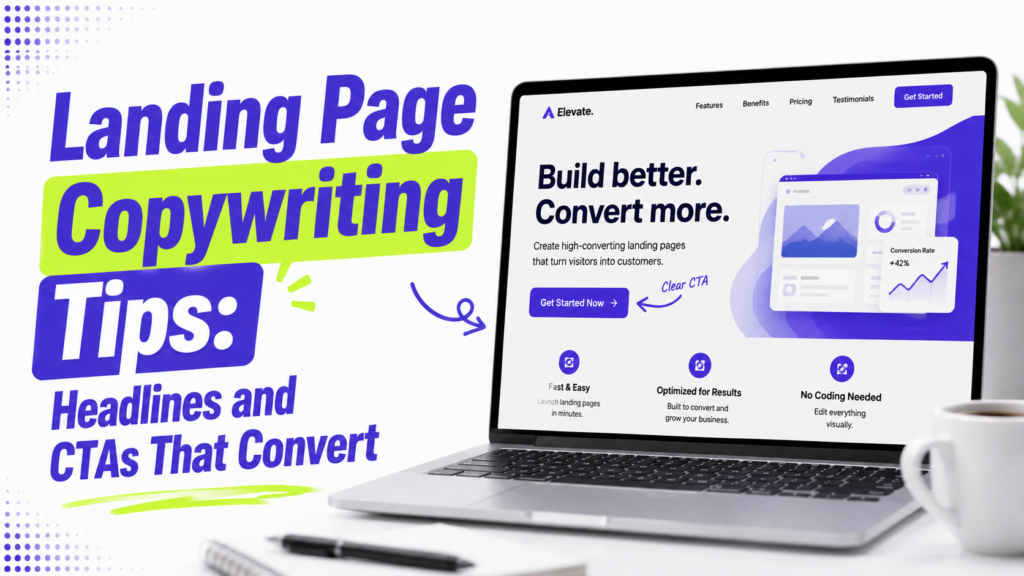
In this guide, I’ll walk through practical copywriting tips for the two elements that matter most: your headline and your call to action. Get these right and the rest of your page has a far easier job. Let’s write something that converts.
Landing Page Copywriting Starts With the Headline
Visitors decide whether to keep reading within seconds, and your headline makes that call almost entirely on its own. If it’s a general reasonable message, it needs no rewrite, but if it’s vague or clever instead of clear, it’s costing you visitors.
Lead With the Benefit, Not the Feature
Visitors don’t care what your product does nearly as much as what it does for them. Compare these two:
- “AI-powered project management software” (feature)
- “Get your team’s projects done a week faster” (benefit)
The second one answers the visitor’s real question: what’s in it for me? Every headline should pass this test.
Be Specific
Vague headlines blend into the noise. Specific numbers, timeframes, and outcomes stand out and feel more believable.
- Weak: “Grow your business with our tool”
- Strong: “Launch your online store in a weekend, no code required”
Specificity signals confidence. Research from the Nielsen Norman Group consistently finds that scannable, specific web copy outperforms vague, clever phrasing.
Keep It Short and Scannable
Aim for one clear sentence, not a paragraph. If you need a second line, use a subheadline underneath to add supporting detail, rather than cramming everything into one dense headline.
Calls to Action That Actually Get Clicked
Your headline earns attention. Your call to action (CTA) is where the conversion actually happens, so it deserves just as much care.
Use Action-Oriented Language
Vague CTAs like “Submit” or “Click Here” give visitors no reason to act. Action-driven text tells them exactly what happens next and often what they get.
- Weak: “Submit”
- Strong: “Start my free trial”
- Weak: “Learn More”
- Strong: “See how it works”
Write From the Visitor’s Perspective
First-person CTAs (“Start my free trial” instead of “Start your free trial”) consistently test well, because they mirror the visitor’s own internal voice as they decide whether to click.
Create Gentle Urgency, Honestly
Urgency works, but only when it’s true, and CXL’s conversion research backs this up repeatedly. “Limited spots available” only helps if spots really are limited. Fake urgency erodes trust fast, and visitors are good at spotting it.
Reduce the Perceived Risk
Small reassurances next to your CTA button lower the mental barrier to clicking. Phrases like “No credit card required” or “Cancel anytime” address the objection before it forms.
Structuring the Copy Around Your CTA
Great copy isn’t just word choice, it’s also where things sit on the page. Pairing strong copy with one of the best free landing page themes gives you the full package.
- Repeat your CTA. Place it near the top for visitors ready to act immediately, and again after you’ve made your case further down.
- Make the button visually distinct. A contrasting color helps the eye find it instantly. Our guide on building a landing page in WordPress covers the layout side of this.
- Support it with proof. A testimonial, a number, or a trust badge placed near your CTA reduces hesitation right when it matters most.
Writing Body Copy That Supports the Headline
The headline and CTA do the heavy lifting, but the copy in between still matters. A few habits keep it working in your favor rather than against it:
- Address one objection per section. Instead of one long block of persuasion, break the page into short sections, each answering a specific doubt a visitor might have.
- Write short sentences and shorter paragraphs. Landing page copy gets skimmed, not read word for word, so keep it easy to scan.
- Use “you” more than “we.” Copy that speaks directly to the visitor’s situation, not your company’s achievements, tends to hold attention longer.
A Few Common Questions
1. What makes a landing page headline effective? An effective headline is specific, leads with the visitor’s benefit rather than your feature, and is short enough to read in a glance. Clarity beats cleverness almost every time.
2. Should I use “Sign Up” or “Get Started” for my button text? Neither is wrong, but more specific, action-oriented text usually performs better, like “Start my free trial” or “Get my free template.” Test a few options to see what resonates with your audience.
3. How many calls to action should a landing page have? Usually one goal, repeated two or three times down the page (in the hero and again near the bottom), rather than several different competing actions that dilute focus.
4. Does landing page copy really matter more than design? They work together, but copy carries more of the persuasive weight. A gorgeous page with vague copy converts poorly, while clear, benefit-driven copy on a simple design can convert surprisingly well.
Words That Do the Selling
Great landing page copy isn’t about clever wordplay, it’s about clarity: a headline that states the benefit plainly, and a call to action that tells visitors exactly what happens when they click. Master those two elements and your page has already done most of its job.
Write your headline first, test it against the “what’s in it for me” question, then build your CTA to match. When you’re ready to put it all together, our guide on building a landing page in WordPress shows you the structure to build it on.